
EA Group members participate in external CIVEX meeting in Maastricht
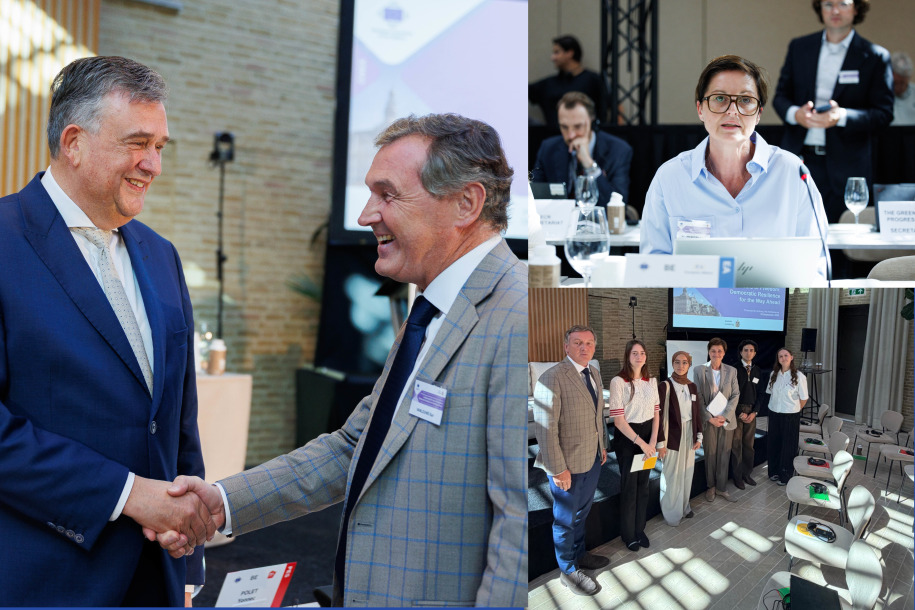
From 8 to 10 September, several members of the European Alliance Group travelled to Maastricht for the annual external meeting of the CIVEX Commission. The EA delegation consisted of Karl Vanlouwe, Griet Vanryckegem, Marc Hendrickx (all Flanders), Mantas Varaška (Lithuania) and Emil Drăghici (Romania). Over three days, members discussed key topics including the Pact for the Mediterranean, the EU Counter Terrorism Strategy and the status of Ukrainian refugees in the EU, and took part in a conference on Second World War remembrance and current threats to democratic resilience.
Pact for the Mediterranean
The meeting opened with a debate on the CoR opinion on the Pact for the Mediterranean. Griet Vanryckegem took the floor on behalf of the EA Group, recalling the important work carried out by EA Group President Nanette Maupertuis within ARLEM: “Our Group fully supports institutionalising ARLEM’s role in implementing the Pact. Local and regional authorities on both sides of the Mediterranean must take ownership, exactly as our Group President Nanette Maupertuis highlighted in her ARLEM report on the Pact, because local and regional authorities play a key role in today’s challenges, from migration to security, and must be heard.” Her intervention underscored the need for stronger political recognition of Mediterranean territories and genuine multilevel cooperation.
EU Counter Terrorism Strategy
The second debate focused on the EU’s new Counter Terrorism Strategy. Speaking on behalf of the EA Group, Karl Vanlouwe recalled his previous work as rapporteur on the 2020 CoR opinion and underlined the continued relevance of the topic: “This opinion rightly puts cities and regions at the centre of counter terrorism. Recent events show how urgent this remains: local and regional authorities need strong cooperation, better information sharing and targeted EU support, including cutting funding to Islamist extremist organisations, to fight radicalisation, embed security by design and safeguard our public spaces.”
Ukrainian refugees
The third major topic addressed during the meeting was the Temporary Protection status for Ukrainian refugees. Marc Hendrickx reiterated the Group’s unwavering support for Ukraine and stressed the daily role of local and regional authorities: “Local and regional authorities are the communities where Ukrainians live, work and where their children go to school, in Mechelen alone we welcome around 1,000 of them. We need a clear long‑term solution for their future, because the Ukrainians rebuilding their lives here today are also the human capital that will help rebuild Ukraine tomorrow.” He emphasised that predictable, coordinated and long‑term solutions are essential as Temporary Protection has now been extended until 2028.
Conference on WWII remembrance
On the second day, members participated in a conference marking 80 years since the liberation of Maastricht. Situated at the crossroads of Germany, Belgium and the Netherlands, the city played a significant role during the Second World War, making it a fitting place to reflect on eight decades of peace. Members engaged in a debate with Dutch secondary‑school pupils on contemporary challenges to peace and tolerance. The discussion focused in particular on the impact of social media on democracy, offering a valuable opportunity for intergenerational exchange.