
MEP Johan Van Overtveldt Guest of the EA Group: “An MFF deal now is almost impossible”
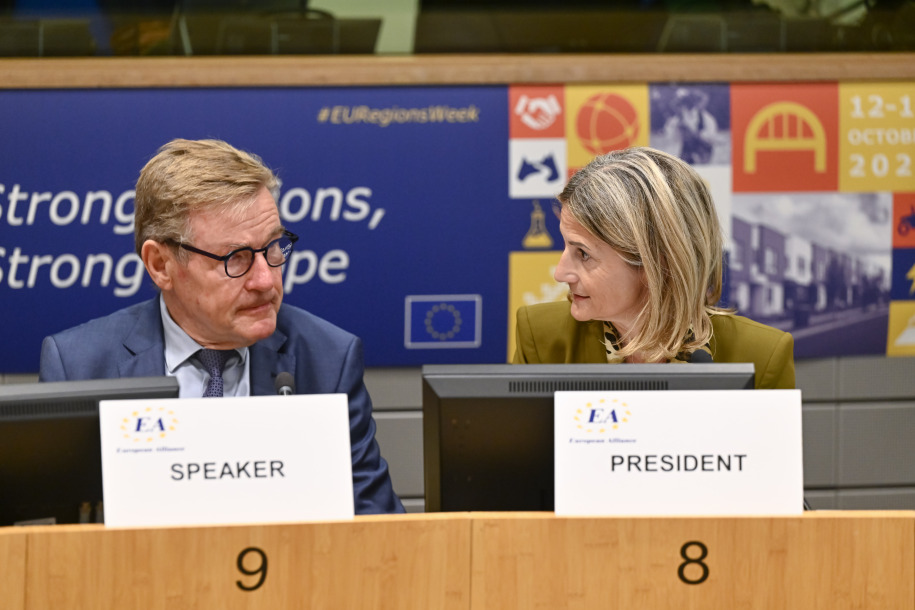
Johan Van Overtveldt, Member of the European Parliament, was the guest of the European Alliance Group at its latest meeting on 14th October, in the context of the CoR Plenary session. He gave members a candid assessment of the state of play in the negotiations on the EU’s next long-term budget and he also answered questions on cohesion funding, rural depopulation and Europe’s industrial competitiveness.
The deal
Van Overtveldt opened by describing the European Parliament’s influence as limited in the negotiation process for the next MFF (Multiannual Financial Framework, that is, briefly, the European Union’s long-term spending plan), even though it does have a say in the outcome. He was sceptical that the Multiannual Financial Framework (MFF) could be settled by the end of the year, calling a deal “almost impossible”. He also argued:” Irish presidency tried to please everybody – nobody is pleased as a result”. Some Member States wanted cuts, while others wanted a bigger budget instead. “This is the eve of difficult negotiations in the Council,” he said, adding that these tensions will certainly carry over into next year.
Giving regions a stronger voice
Van Overtveldt pointed to the Corona recovery fund as a concrete case for making regional voices heard at European level. He encouraged EA Group members to engage with MEPs and press for a stronger role for regions in EU legislation.
Questions from members
Czarzyńska-Jachim, mayor of Sopot, Poland, observed that few, if not anyone, is satisfied with the current happenings at the EU level, and that there is no real process of decentralisation at national level. Van Overtveldt replied that some national governments are “allergic” to a bigger role for regions, and so, he suggested to regional authorities to be the first ones doing the first step and talk openly to their national governments.
McDonnell, councillor of Galway, asked what the latest acceptable date for a decision would be, and whether the Irish Government had done enough to protect cohesion. Drawing on his experience of a past MFF, the MEP estimated that an agreement is likely around June or July 2027, and said he would be surprised to see one by the end of this year. He said that in a way, the Irish Presidency did protect cohesion: by not touching it. However, he warned that it is unclear whether this will hold, given the heavy pressure between Member States, with some prioritising other fields, like agriculture for example, and others cohesion.
Responding to Iwaniuk (Mayor of Terespol, Poland) who raised questions about rural areas and depopulation, Van Overtveldt urged policymakers to “have the courage” to look closely at where the money is actually going. He said cohesion funding should be rethought, not cut, with a sharper focus on where it is invested.
The geopolitical side of it
Marie-Antoinette Maupertuis, President of the Corsican Assembly and of the group, argued that the geopolitical situation is disrupting the cohesion policies that began with Jacques Delors, and called for new forms of governance. She stressed that the EU will only be strong if it supports its regions, especially rural and peripheral areas. As a last question, the president asked the MEP whether the “frugal” countries would act in the negotiations or not, and the answer was assertive: Van Overtveldt’s “no” echoed in the room. He pointed to Germany, where the political climate, including the rise of specific extreme parties, means a very firm and unmovable position should be expected. He lamented the lack of an overall European vision and he warned that without decisive action Europe risks losing its industrial base, followed by a complain about China’s way of behaving in the international economic scene. On this matter, his recommendation was blunt: impose an import tariff on everything coming from China, and show that “Europe means business”. By doing that, he called on EU leaders to bring these elements together with “intellectual decisiveness” and turn them into good European legislation.